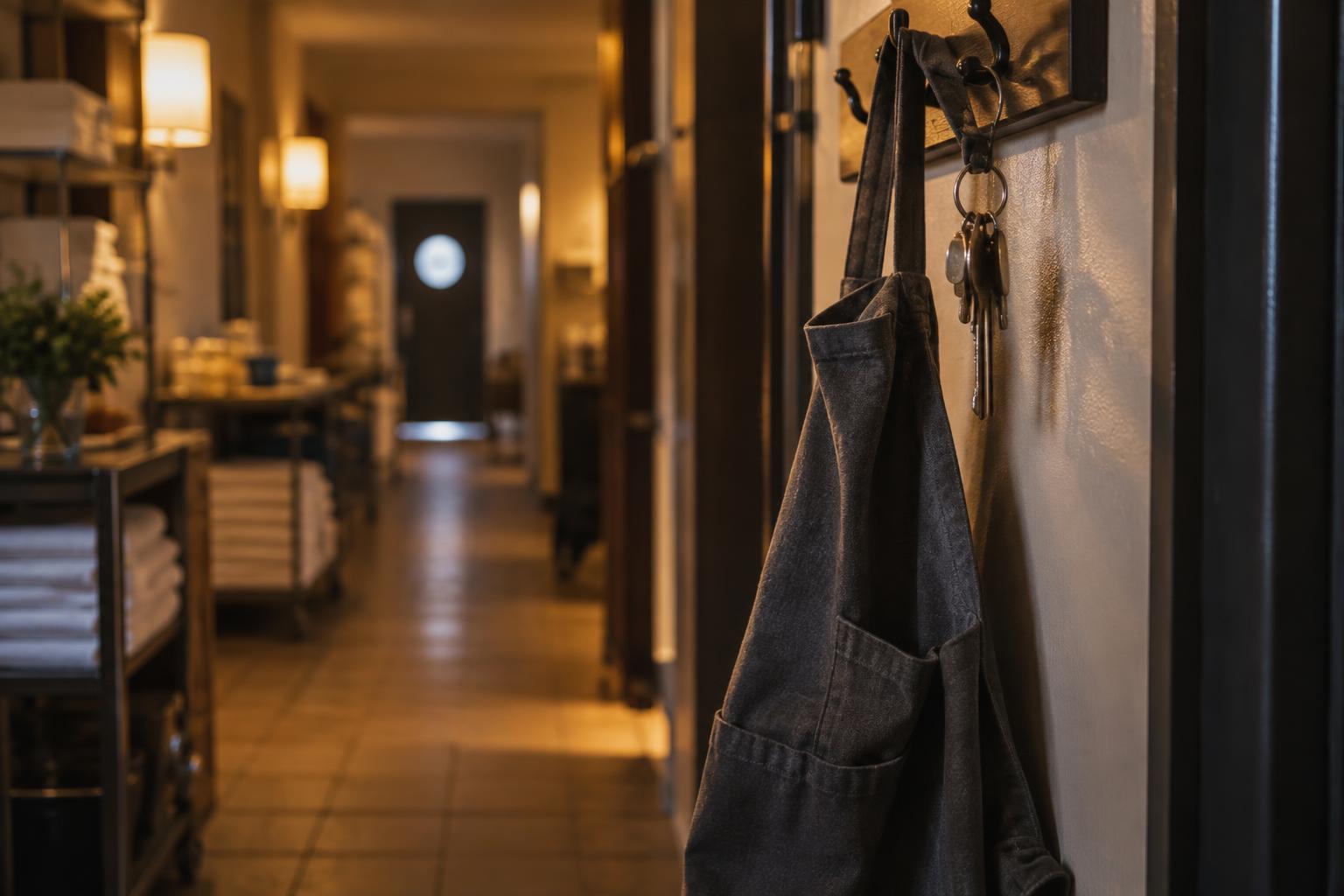
The end of the season in a small venue has a familiar sound: the last day, a bag on the shoulder, "Good luck, see you next year!" A nice moment, but it hides a question that is rarely asked out loud: what walked out of the door together with the employee?
I am not talking about the hands. Hands can be found. I am talking about the answers they knew by heart and that nobody ever wrote down.
What an experienced employee actually knows
Take an employee who has worked at the reception of a guest house all summer. Without thinking, they know:
- that the car park is at the back, but when it is full, cars are left on the street in front of the entrance, and that the gate opens by pushing, not pulling;
- how late breakfast runs on Saturdays and what to say to a guest who arrives at 10:40;
- that with a guest who has a dog, the size is clarified and they are reminded about the carpet in the ground-floor room;
- which of the rooms is noisier in the evening and to whom it should not be offered;
- what to reply to an enquiry from a group when the owner is out on site;
- which plumber picks up in the evening and where the spare key is.
None of this is a secret. But none of it is written down either. It lives in one person's habit, and the habit leaves with them.
How to see the risk before you have paid for it
The risk is easy to underestimate, because in summer everything works. The employee answers, the guests are happy, the owner does not give it a thought. The price shows only when a new person arrives. Try the following small test.
During the new employee's first two weeks, keep a simple note: every time they ask you something, write the question down. At the end you will have a list. If it has twenty to thirty questions, most of which you explained last year as well, that is the size of the knowledge that was never written down.
A second sign: when the experienced employee is on a day off, the phone rings for you. If they always ask you and not the stand-in, the stand-in has nowhere to learn the answer.
A third sign: two different people give a guest two different versions of the check-in time or of the pet policy. That is not ill will, but the lack of a common source.
Why passing it on by word of mouth is not enough
Many owners rely on "the previous person will train them before they leave". Often this passes on what is visible, not the exceptions. The last two days of the season are the busiest, and training on the go comes down to a few quick instructions. The exceptions that make the difference are not mentioned, because nobody thinks of them until they happen.
Besides, knowledge passed on orally gets distorted. The new person carries it over in their own way, and the next one in an even more their own way. After two shifts, the answer about the car park differs from the real one.
What to write down and in what form
Do not start with a twenty-page manual. Start with the questions.
- Take the last ten or so days of messages and calls and underline every guest question.
- Group them: arrival and check-in, room and amenities, breakfast and meals, prices and conditions, surroundings and transport, what to do in case of a problem.
- Next to each question, write the answer the way you would say it to a guest: short, clear, with a time, address or rule, if there is one.
- Mark separately what the employee does not decide alone: a discount, a change to a reservation, a complaint. There the owner is called and nothing is promised.
This gives you a document that the new person can read in one afternoon, not in a week. On the first day they already know what to say to a guest who asks about the car park.
Who keeps it up to date
The most common reason notes do not work is that they go out of date. In March the price of breakfast changes, in June a new car park opens, and the text stays from last year. Outdated information is more harmful than none, because it sounds confident.
So appoint one responsible person, usually the owner themselves, and one occasion for review: the start of the season and every larger change. The whole review takes about an hour if the notes are short.
Where an automatic reply can help
Written answers have one more benefit: an automatic assistant for guests can use them too. ISKA Assistant answers only on the basis of information approved by the venue. When there is no data, it does not make anything up but directs the guest to the venue's phone. There is no live chat with a person, and it does not replace the reception. It can take a room reservation request and record it as a new one, and the team confirms it. Conversations are reviewed in the Inbox, so the owner sees what guests ask and what is still missing from what has been written down.
Note the direction: first come the written answers, then the technology. If the answers are not written, there is nothing to approve. If they are, they serve both the new employee and the guests. The price and the packages are on the pricing page.
A small plan for next season
- Before the employee leaves: one hour to list the questions they hear most often and add an answer to each.
- During the new person's first week: read the notes and make a note of everything that is missing.
- At the end of the week: the owner completes and corrects the list.
- At the start of every season: a general review of prices, times and rules.
Knowledge does not stay by itself. It stays when it is written down, when someone reads it and when someone corrects it. These are three small actions, but they decide whether the next shift starts with ready answers or with the usual "well, I don't know, I'll ask".